
|
Makeup Home | History | Testing | Mascara | Tools & Types | Applying Makeup |
|
"Over 15 million warm-blooded animals are used in research every year." |
|
Every year,
millions of animals suffer and die in painful tests to determine the
"safety" of cosmetics and household products. Substances are tested
on rabbits, rats, guinea pigs, dogs, and other animals, despite the
fact that test results do not help prevent or treat human illness or
injury.
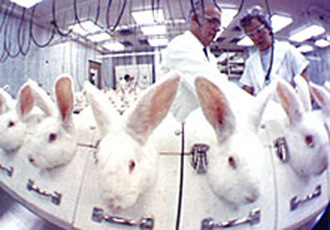
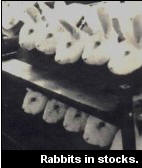
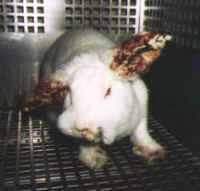
In these tests, a liquid, flake, granule, or powdered substance is dropped into the eyes of a group of albino rabbits. The animals are often immobilized in stocks from which only their heads protrude. They usually receive no anesthesia during the tests. After placing the substance in the rabbits' eyes, laboratory technicians record the damage to the eye tissue at specific intervals over an average period of 72 hours, with tests sometimes lasting 7 to 18 days. Reactions to the substances include swollen eyelids, inflamed irises, ulceration, bleeding, massive deterioration, and blindness. During the tests, the rabbits' eyelids are held open with clips. Many animals break their necks as they struggle to escape. The results of eye irritancy tests are questionable, as they vary from laboratory to laboratory-and even from rabbit to rabbit. Acute toxicity tests, commonly called lethal dose or poisoning tests, determine the amount of a substance that will kill a percentage, even up to 100 percent, of a group of test animals.
Animals are kept in clear, white, plastic boxes, or wire cages depending on the size of the animal. Usually, more than one animal lives in a box. Social primates like monkeys often live with other monkeys, but most other large animals usually live alone. Often, primates get to spend some time every day in a larger cage where they can play. Most other animals stay in their cages all the time except when they are being used in experiments. Strict laws insure that the cages are warm, clean, and big enough. However, they are still kept in cages. A cage can never be as interesting, stimulating, or open as a natural habitat. This can be a problem--especially for the more intelligent animals like dogs, cats, pigs, and primates. They can become tremendously lonely and bored unless they have things to play with or ways to get more exercise.
|
|
It's impossible to now exactly how many animals are being used in research because U.S. laws do not require scientists to report how many mice, rats, or birds they use. There are many animals that scientists do have to report using in experiments, including dogs, cats, sheep, hamsters, guinea pigs, and primates. Of the animals that the US Department of Agriculture (USDA) collects numbers on, 1,438,553 were used in research in 2002.
Although more than half
of the animals used in research do not feel pain or distress during the
experiments, 489,262 animals that were used in research last year (not
including mice, rats, and birds--no one knows how many of these animals are used
in research) were used in research that was either painful, distressful, or
both. Most of these animals were given something that either helped take
the pain away or helped them get over the pain quickly. For example, most of the
animals that underwent surgery were given anesthesia first so they would be
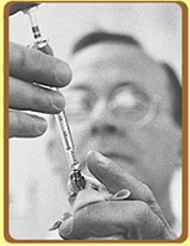
"asleep" during the surgery. Unfortunately, 103,764 of the animals made to feel pain were not given anything to reduce their pain and suffering. This means that more than 100,000 animals were made to feel pain and fear in 2002. Although some of this pain was slight--like getting an injection with a needle--some of it was extremely severe.
|
|
Scientists must have stronger reasons to do research on animals now than they used to if they want the IACUC to let them do the research. The animals that are in labs must be treated better now. If scientists do not follow the law, they can be punished.
|
|
For a list of companies that DO and DONOT test their products on animals visit Caringconsumer.com's list. |

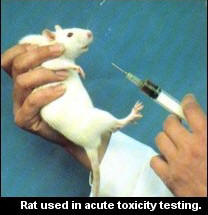 In
these tests, a substance is forced by tube into the animals'
stomachs or through holes cut into their throats. It may also be
injected under the skin, into a vein, or into the lining of the
abdomen; mixed into lab chow; inhaled through a gas mask; or
introduced into the eyes, rectum, or vagina. Experimenters observe
the animals' reactions, which can include convulsions, labored
breathing, diarrhea, constipation, emaciation, skin eruptions,
abnormal posture, and bleeding from the eyes, nose, or mouth.
In
these tests, a substance is forced by tube into the animals'
stomachs or through holes cut into their throats. It may also be
injected under the skin, into a vein, or into the lining of the
abdomen; mixed into lab chow; inhaled through a gas mask; or
introduced into the eyes, rectum, or vagina. Experimenters observe
the animals' reactions, which can include convulsions, labored
breathing, diarrhea, constipation, emaciation, skin eruptions,
abnormal posture, and bleeding from the eyes, nose, or mouth. 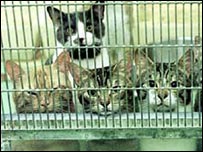


 Since
more than 1.4 million mammals other than rats and mice were used in research,
and since mice and rats probably make up 90% of the animals in labs, we can
guess that about 14 million rats and mice were used in research in 2002.
That means that over 15 million warm-blooded animals are used in research every
year.
Since
more than 1.4 million mammals other than rats and mice were used in research,
and since mice and rats probably make up 90% of the animals in labs, we can
guess that about 14 million rats and mice were used in research in 2002.
That means that over 15 million warm-blooded animals are used in research every
year.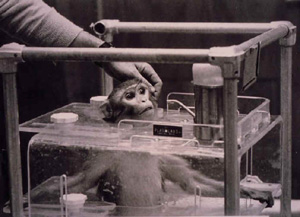

 The
situation is not perfect, and more needs to be done, but things have
gotten better. Now, scientists need to have their research approved
by a committee called
The
situation is not perfect, and more needs to be done, but things have
gotten better. Now, scientists need to have their research approved
by a committee called