 |

|
|
Cloning is the production of one or more individual plants or animals that are genetically identical to another plant or animal. What is a clone? A clone is a group of organisms or other living things with exactly the same genetic material. Genetic material consists of genes, which are the parts of cells that determine characteristics in living things. It is called “twinning” because it is a natural process that creates identical twins. It involves splitting a developing embryo soon after the fertilization of the egg by a sperm to give rise to two or more embryos. How to clone a Human! This isn’t a joke! Dr. Lee Silver of Princeton University is a expert on cloning. This procedure was based upon sheep cloning procedure. Materials Human tissue- pure human cells of one tissue type, from one person who would like to be cloned. Laboratory supplies: Incubator, Sterile Hood, Petri dishes, microscopes, and tools capable of removing and implanting a cellular organelles, like the nucleus. Unfertilized human egg cells Procedures 1. Grow the human cells that will be cloned. 2. Transfer the cells. 3. Get a unfertilized human egg cell. Remove the nucleus from the egg cell. 4. Take one of its quiescent cells and implant it into the coat around the egg next to the egg. 5. Electroshock the egg. Electro shocking will help the fusion of the two cells. The electroshock might assist in moving those protein signals across the nuclear membrane. The electroporation is the common technique for moving the DNA molecules through the cellular membrane. 6. Implant the embryos in the human mothers, and there they will be carried to term and will be born normally. Why clone? A goal of cloning and of similar research is to develop ways to alter animals genetically and to reproduce them. Another use is to develop drug-producing animals as well as inactivating genes. We can study the effects and possibly create animal models of human diseases. Cloning technology some day might enable us to produce whole organs from a single cell. Even to raise animals who have genetically-made organs to give to humans who need them.
|
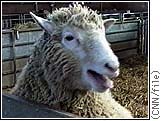
Up to 1966, cloning techniques failed to work. Scientists concluded that the mature cells used were too specialized to work. Led by Ian Wilmut, research of the Roselin Institute, in Scotland, found a way to make cloning happen. His team took cells from an adult sheep and placed them in a solution that starved them of nutrients. Within a few days they stopped growing. Then they removed the nuclei of young unfertilized egg cells and fused the cells to the adult sheep cells using electricity. Then they allowed the cells to grow into embryos, which were then transplanted into female sheep to complete their development. Of almost three hundred attempts, only one lamb was born healthy, and survived. All the other embryos failed. The failures were because sometimes either the eggs did not accept the mammary cell nuclei, or the embryos that were produced died, or the lambs were born abnormal and died. Finally, one special, healthy lamb was born; in July of 1996. She was named Dolly. Dolly was born in July 1996. This experiment proved that the nucleus of a specialized adult cell could be reprogrammed to direct the development of a new organism.
An important technical point of the research was that the nucleus of the special body cell from the adult sheep could be reprogrammed to direct the development of a new organism. When the scientist starve the cells it makes the programming easier because the cells are not growing. Programming the nucleus is a process of the cytoplasm and the genes. Cytoplasm is the cellular substance surrounding the nucleus. The cytoplasm sends the nucleus signals that determines which genes are turned off or on. There are many ethical concerns about cloning. Researchers have also tried to clone goats. |